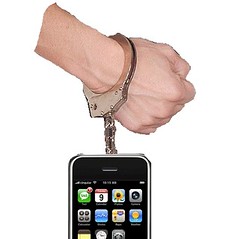
iphone

Support DbD at Apple's Jan. 27 "Come see our latest restriction" event in SF

Posted On: Fri, 2010-01-22 15:11 by JohnSullivan

Update 2010-01-25: We will be meeting outside the Theater at 8:30am (Wednesday 27th), and will go until at least 10:30am. Stay tuned to http://identi.ca/dbd for updates and coordination.

This coming Wednesday, January 27th, Apple has invited members of the media to San Francisco's Yerba Buena Center for the Arts Theater to "Come see our latest creation."
There has been much speculation about what Apple will be announcing, with most of it revolving around a possible tablet PC -- basically an oversized iPhone. But no matter the form factor, it's all but certain given the direction Apple has been going that any new product will be DRM-infected and restricted by proprietary software.

Share this story! — Digg or reddit

The company who once announced to the world that they opposed DRM on music has been pushing DRM in every other area of their business. Apple's iPhone goes out of its way to apply DRM on every piece of software on the device, saying it is illegal for users to install software that comes from anywhere other than the official Application Store.

Can you imagine a world where this same restriction is applied to your laptop or tablet PC? That could very well be Apple's announcement on Wednesday -- their latest restriction.

As in the past, they didn't invite us to the event, but we thought we would go anyway, and bring some friends. We'll be there to warn the public and the media outside the event about Apple's support for DRM and proprietary software.

Come help create the counter story in the media -- take photos, talk to the press, and have fun with a little bit of theater to show that Apple is not the force for creative expression they claim to be.

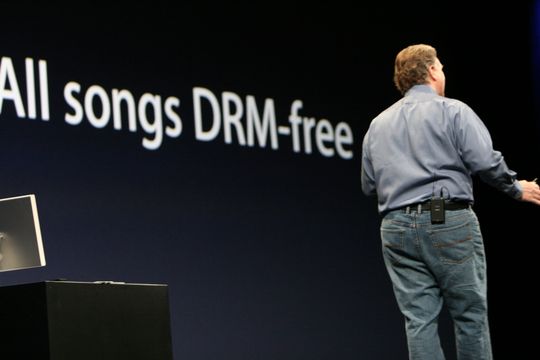
We got through to Steve Jobs before on music DRM, and convinced iTunes to drop it. We know we can have success here. But we need to repeat that effort and show that DRM on Apple computers means that people who are actually interested in creativity and freedom will go elsewhere.

Press coverage of Apple events usually falls all over itself to praise the style and sleekness of their devices. It's vital that we be there to unmask the new product for what it undoubtedly will be -- another seamless case and pretty screen hiding a new set of restrictions and threats to the public's digital freedom.

We'll post the precise time and meeting location for our group here next week -- since Apple's event starts at 10am, attendees will be showing up at 9am, and we will want to be ready and outside the Theater by then to hand out flyers and talk to people.

I'll be there representing the FSF and coordinating the action. Please join us, and bring friends. Let us know you're coming at info@defectivebydesign.org.

We'll meet at 8:30am outside the Theater.

Share this story! — Digg or reddit

John Sullivan
DRM Elimination Crew
FSF Operations Manager
( FILED UNDER: )

Apple says you can't have freedom because you might be clumsy, evil, and a drug dealer

Posted On: Thu, 2009-07-30 13:33 by JohnSullivan

Apple's lawyers, led by David L. Hayes of Fenwick & West LLP, claimed in comments submitted to the US Copyright Office that the Digital Restrictions Management (DRM) system on the iPhone is necessary to combat drug dealers, safeguard the cell phone network, and prevent you from hurting yourself.

Digg this story

They submitted these comments in response to the Electronic Frontier Foundation's request that users be able to "jailbreak" their iPhones -- which means circumventing Apple's DRM system so that they can install their own applications, just like you can do on any other computer and many other cell phones already.

Apple seems to have missed that last part -- just like you can do on any other computer and many other cell phones already. Instead, they claim that users removing the DRM system are criminals, who should be prosecuted. They say that if you can modify your own phone -- as in, if you install an application from anyone but Apple -- you might deliberately bring down the whole cell network or make anonymous phone calls to arrange drug deals. You might also break your phone.

I already have a phone that lets me do the kinds of things Apple is talking about. It's nearly all free software -- the source code lives in plain view in places like here and here, if you want to see it. Some of my friends use this software on their phones. None of this software is completely free yet, but it's free in the ways that Apple claims are threatening, and it doesn't have DRM. Please don't follow those links if you're a malicious person (or a drug dealer). Certainly don't look at this one.

I and many other users already have the freedoms that Apple is trying to destroy. We have these freedoms because software authors other than Apple are willing to share their work and encourage other users and authors to tinker with it. And thankfully, the anti-circumvention provisions of the Digital Millennium Copyright Act (DMCA), which give DRM its legal teeth, have so far failed to stamp out innovation even in the case of restrictions like Apple's. This means that appealing to copyright law to stop any sort of malicious action is completely disingenuous. If my friend's fourteen-year-old brother can jailbreak his dad's iPhone, I'm pretty sure Al-Qaeda can figure it out, no matter what the Copyright Office decides.

But Apple isn't concerned with your safety or security anyway. They are concerned with their profits. On the iPhone, even programs offered at no charge by people who would voluntarily let you copy their work as many times as you want, that only do something local on your own phone, without accessing the network, are restricted by DRM. What does that have to do with network security, or copyright?

As expert Bruce Schneier says, with iPhone, "security" is code for "control". The real reason for DRM on the iPhone is exactly what he says it is:

Control allows a company to limit competition for ancillary products. With Mac computers, anyone can sell software that does anything. But Apple gets to decide who can sell what on the iPhone. It can foster competition when it wants, and reserve itself a monopoly position when it wants. And it can dictate terms to any company that wants to sell iPhone software and accessories.

Apple claims throughout their comments that if users can modify their devices, they might break them. They say, "The modifications to the bootloader and the OS made to jailbreak a phone result in those programs being used in ways that were never envisioned in their creation." Yes, that's called innovation, and creativity. It is true that when you tinker with things you can break them. While I appreciate Apple's apparent concern for my well-being, I would request that they leave those decisions and their consequences to me. I've lived most of my life with a computer that I can tinker with, and while it leads to endless hours of frustration, it's also the way I and many other people learn how machines and software work. People that don't want to tinker don't have to -- but who thinks that all tinkering, or any meaningful kind of user freedom, must be made illegal to protect people from hurting themselves?

Apple is right in another regard -- such freedom does come with some social ills. For example, big companies that engage in socially destructive unethical behaviors. It also comes with the reality that individuals will sometimes do violent and destructive things. But we don't respond to those threats by abandoning individual freedom, and we certainly don't respond to them by investing the authority to decide the limits of individual freedom in a single company through their proprietary code.

If we don't choose freedom over fear in this situation, then we have a whole lot more to rethink than just DMCA exemptions. Ironically, if we had followed Apple's advice and failed to choose freedom in the past, the iPhone and their OS X operating system might not have even been possible. Flip through the licensing section of the iPhone's software. You will find numerous free software licenses. The iPhone is built on a core of free software. It is built using programs that were later modified by people around the world in "ways that were never envisioned in their creation," which have now had their freedoms stripped away by Apple.

This is a company happy to profit from the free software made available by others, and from the creative, innovative process engendered by software freedom and DRM-free computers, which now wants to kick the ladder away to prevent anyone else from doing the same. How is any kid supposed to learn to be a programmer if she can't install her own programs on her own phone? How is the next Knuth supposed to make computer science breakthroughs if he or she can't have access to a computer that will let itself be programmed?

Greed like Apple's, which will stoop to the lowest kinds of threats to justify crippling everyone else's potential, is the threat to our fundamental security that we should be worried about.

But you know what? I agree with Apple. Don't jailbreak your iPhone. Don't buy an iPhone at all. Don't give your money to a company that turns around and gives it to lawyers like Fenwick & West to lobby your government to restrict your freedom -- even if you can manage to (rightfully) claim your freedom back after completing the transaction with them.

Oh, and all this of course explains why you can't open the battery cover on your iPhone. You might put a bomb in there!

You can help fight this nonsense by writing Steve Jobs at sjobs@apple.com and letting him know that you won't buy an iPhone because of its proprietary software and DRM -- and CC the DefectiveByDesign.org campaign at info@defectivebydesign.org.

( FILED UNDER: )